Play-Based Learning vs Structured Learning: Which Is Better for Young Children?
When parents start looking for a preschool or kindergarten, they often compare different teaching approaches. One of the most common questions is: Is play-based learning better than structured learning for young children?
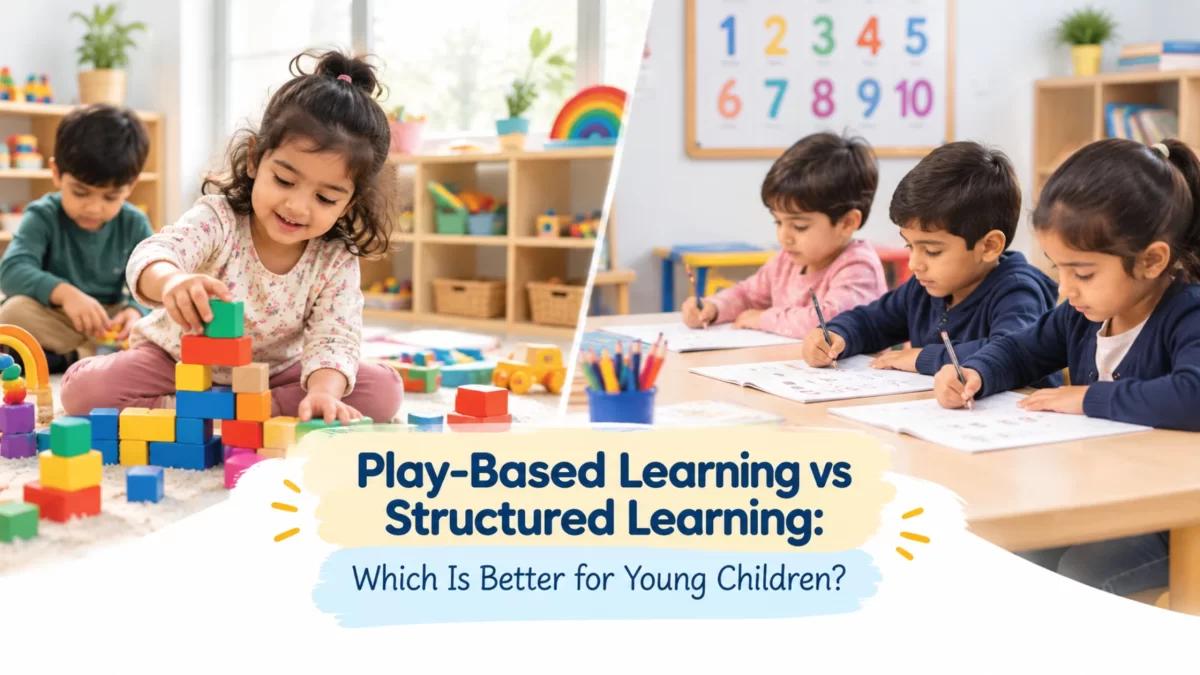
The answer is not as simple as choosing one approach over the other. Traditional classrooms often focus on structured lessons, worksheets, repetition, and teacher-led instruction. Play-based learning, on the other hand, offers opportunities to explore, experiment, create, and learn through meaningful play.
For young children, learning is not simply about sitting quietly, memorizing information, or completing worksheets. Their early years are also crucial for developing language, confidence, social awareness, problem-solving abilities, independence, and curiosity.
Understanding the difference between play-based learning and traditional teaching can help parents make a more informed choice for their child’s early education.
What Is Play-Based Learning?
Play-based learning is an approach where children learn through meaningful play, exploration and hands-on experiences. Activities such as building with blocks, storytelling, role-playing, puzzles, art, music, and outdoor play allow children to learn while actively participating. Teachers guide children during these activities and help them learn from their experiences.
Key Features of Play-Based Learning
- Exploration and Discovery: Children learn by exploring their surroundings, asking questions, and trying new ideas.
- Social Interaction: Group activities help children develop communication, collaboration, sharing, and empathy.
- Creativity and Imagination: Storytelling, pretend play, and art, and other creative activities encourage children to express their ideas.
- Hands-On Learning: Children learn by using materials, helping them understand concepts in practical ways.
Benefits of Play-Based Learning
- Supports Cognitive Development: Play encourages problem-solving, decision-making, memory, and critical thinking.
- Builds Language Development: Stories, conversations, songs, and role-play help children learn new words and communicate more clearly.
- Develops Social-Emotional Growth: Children learn to take turns, cooperate with others, express emotions, and understand others.
- Builds Curiosity and Confidence: Opportunities to explore and make choices can encourage curiosity, independence, and confidence.
Overall, play-based learning helps children develop academic and life skills through activities that feel natural, engaging, and enjoyable.
What Is Structured Learning?
Traditional teaching generally follows a more structured, teacher-led approach. Children learn through planned lessons, direct instruction, repetition, and guided practice. This approach can help children build basic academic skills while also getting used to classroom routines and expectations.
Key Features of Structured Learning
- Structured Lessons: Learning follows planned activities and clearly defined objectives.
- Fixed Timetables: Daily routine gives children a sense of predictability and comfort.
- Teacher-Led Instruction: Teachers introduce new concepts, demonstrate skills, and guide children as they practice.
- Focus on Foundational Academics: Letters, sounds, numbers, shapes, writing, and other basic concepts taught systematically.
- Practice and Reinforcement: Repeated practice helps children remember and become familiar with newly introduced skills.
Benefits of Structured Learning
- Builds Academic Foundations: Direct instruction can help children develop early literacy, numeracy, and other basic academic skills.
- Creates Discipline and Routine: Consistent schedules and classroom routines help children understand expectations and develop regular habits.
- Provides Focused Practice: Structured activities give children time to practice and reinforce what they have learned.
- Makes Progress Easier to Track: Clearly defined learning objectives can help teachers observe and track children’s development.
Structured Learning can therefore provide structure, consistency, and clear guidance, particularly useful when children benefit from direct instruction and repeated practice as part of their early learning.
Play-Based Learning and Structured Learning: What’s the Difference?
| Aspect | Play-Based Learning | Structured Learning |
| Learning style | Exploration and hands-on experiences | Direct instruction and guided practice |
| Teacher’s role | Facilitator, observer, and guide | Instructor and lesson leader |
| Child’s role | Actively participates and explores | Follows structured lessons and activities |
| Activities | Games, stories, role-play, art, building, and exploration | Worksheets, books, exercises, and practice activities |
| Classroom structure | Flexible but follows planned routines | More fixed, structured, and predictable |
| Key strengths | Creativity, problem-solving, communication, confidence, and social skills | Focus, routine, practice, and foundational academic skills |
Why Is Play Important in Early Childhood?
For young children, play is more than just entertainment. It is one of the natural ways children explore, understand, and learn about the world around them.
When children play, they often have to make decisions, communicate with others, solve problems, remember information, and try different ways to complete a task.
For example, when a group of children builds a structure with blocks, they may naturally practice:
- Counting and basic math concepts
- Spatial awareness
- Fine motor skills
- Communication
- Cooperation
- Problem-solving
- Creativity
- Decision-making
Similarly, pretend play can encourage children to build language skills, understand different perspectives, and express their ideas.
This makes play especially valuable during the early years, when children are developing multiple skills at the same time through experiential learning.
Does This Mean Structured Learning Is Not Important?
Not at all.
While play provides valuable learning experiences, young children also benefit from structure, guidance, and clear routines.
Young children still need guidance to learn foundational concepts such as letters, sounds, numbers, vocabulary, and basic classroom routines. Teacher-led activities and guided practice can be helpful when introducing a new concept.
The concern is not necessarily about structured learning itself. The bigger question is whether children are spending too much time on passive learning, worksheets, or academic pressure, especially when they are still developing socially, emotionally, physically, and cognitively.
For young children, learning works best when they have opportunities to listen, participate, explore, practice, create, and apply what they learn.
So, Which Is Better: Play-Based or Traditional Teaching?
For young children, play-based learning can be especially effective, offering opportunities to explore, experiment, and learn through experiences that feel natural and engaging.
However, that does not mean structured or teacher-led learning has no place in early education. Children also need guidance, routines, and opportunities to build foundational academic skills.
Rather than choosing one approach over the other, a balanced learning environment combines the strengths of both approaches together.
Children can benefit from:
- Structured classroom routines that create consistency and security
- Teacher guidance to support learning and development
- Direct instruction when introducing new concepts
- Hands-on activities that allow children to learn by doing
- Play and movement to keep learning active and engaging
- Storytelling and conversation to develop language and communication
- Creative activities that encourage imagination and self-expression
- Repetition and practice to reinforce important skills
- Individual and group activities that support different learning needs
What Should Parents Look for in an Early Learning Classroom?
Instead of asking only whether a school follows play-based or structured learning, parents can look at what children actually experience throughout the day.
Here are some questions parents can consider:
- Do children get opportunities to explore and ask questions?
- Are activities appropriate for their age and developmental stage?
- Does the teacher actively interact with and support children during activities?
- Is there a balance between structured learning and exploration?
- Do children get opportunities to learn both independently and in groups?
- Are creativity, communication, and social skills encouraged alongside academics?
- Does the classroom environment make children feel comfortable participating?
- Are children given enough time to learn and develop at their own pace?
Looking at these aspects can give parents a much better understanding of a school’s approach than simply asking whether it is “play-based” or “traditional.”
Parents can also explore what to look for when choosing among nursery schools in Gurgaon.
How The Beacon School Brings Learning and Play Together
At The Beacon School, the early years approach is designed to be meaningful, engaging, and appropriate to each child’s stage of development.
The school’s Primary programme combines playful exploration and hands-on learning with structured academic experiences. Children learn through storytelling, role-play, outdoor exploration, sensory experiences, and integrated learning units. Reading and writing follow a structured phonics-based approach, while mathematics is introduced through games, manipulative, and real-life situations.
This balance allows children to learn with curiosity and confidence while developing intellectually, emotionally, socially, and creatively.
Rather than rushing children towards academic milestones, The Beacon School focuses on building strong foundations through joyful, experiential learning that encourages children to explore, question, create, and discover.
A Balanced Approach to Early Learning
The debate between play-based learning and structured learning does not have to be an either-or choice.
Young children need structure, but they also need opportunities to explore. They need teachers who introduce new concepts, but they also need time to discover, experiment, and learn through experience.
They need foundational academic skills, but they also need time to develop communication, creativity, confidence, collaboration, and problem-solving.
A balanced approach recognizes that early education is about much more than completing worksheets or meeting an academic checklist. It is about creating positive learning experiences that help children become curious, confident, capable, and ready to learn.
At The Beacon School, early learning can be approached as a combination of age-appropriate guidance, meaningful activities, exploration, and interaction. For parents exploring preschool or kindergarten school in Gurgaon, looking beyond worksheets and academic outcomes can help them understand what truly supports a child’s development in the early years.
Frequently Asked Questions
Q1. Is play-based learning better than structured learning?
For young children, play-based learning can support learning and development by combining exploration, interaction, and hands-on experiences. However, structured instruction also has a role, and a balanced approach can bring together the strengths of both methods.
Q2. Does play-based learning include academic learning?
Yes. Play-based activities can support early literacy, numeracy, language, problem-solving, and other foundational skills while also developing social and emotional abilities.
Q3. Does play-based learning mean children play all day?
No. Effective play-based learning is purposeful and guided. Teachers plan activities, introduce concepts, observe children, ask questions, and support learning while giving children opportunities to explore.
Q4. What is the best teaching method for young children?
There is no single method that works identically for every child. A developmentally appropriate approach can combine teacher guidance, structured routines, hands-on activities, play, practice, and opportunities for independent exploration.
Q5. How can parents identify a good early learning environment?
Parents should look for purposeful activities, engaged teachers, age-appropriate learning, opportunities for social interaction, hands-on experiences, predictable routines, and a clear approach to foundational literacy and numeracy
Q6. Does The Beacon School use play-based learning?
The Beacon School’s Primary programme incorporates playful exploration and hands-on learning alongside structured learning experiences. Its programme includes integrated learning units, a phonics-based reading and writing journey, math through play, speech development, and other experiential activities.