
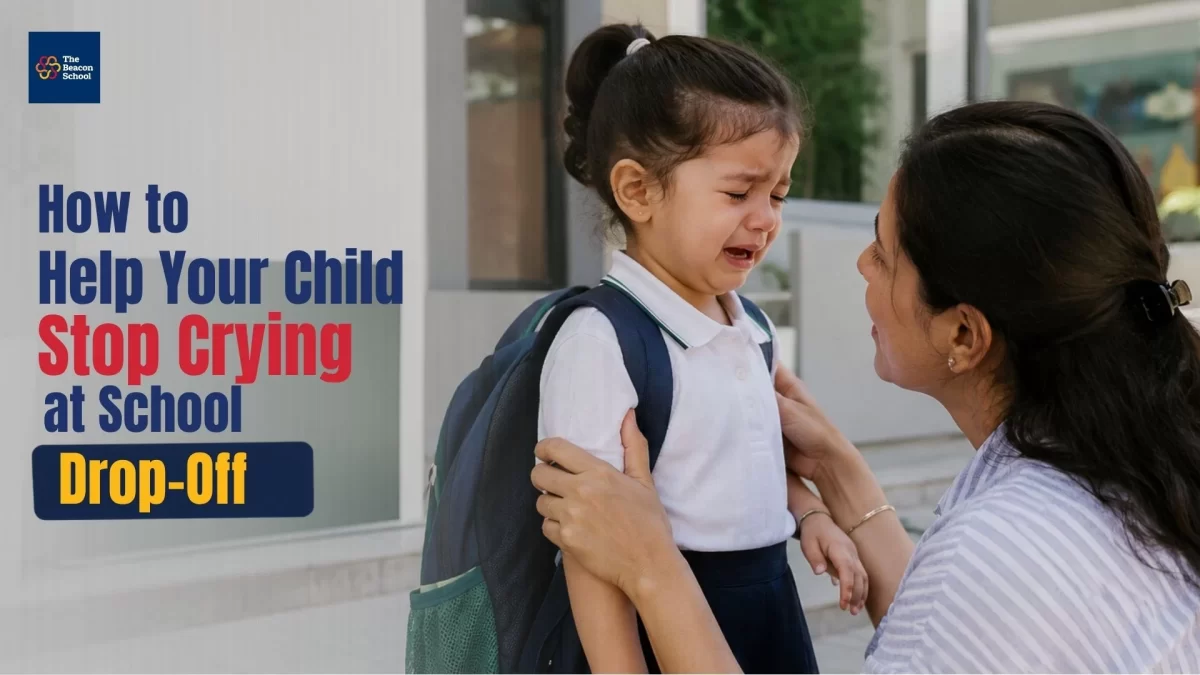
How to Help Your Child Stop Crying at School Drop-Off
If your child clings to you every morning at the school gate and bursts into tears the moment you try to leave — this is completely normal, and it almost always passes sooner than parents expect. Separation anxiety at drop-off is one of the most common concerns among nursery and kindergarten parents in Gurgaon, and the good news is that both you and your child can get through it with the right approach — and the right school environment.
Here is what actually helps, what makes it worse without parents realising, and why the school your child attends plays a bigger role in this than most people talk about.
Is It Normal for a Toddler to Cry at School Drop-Off?
Yes — and it is actually a sign of healthy attachment. Children between 18 months and 5 years are developmentally wired to feel distress when separated from their primary caregiver. It means the bond is secure. The anxiety is not a problem to be fixed — it is a stage to be navigated thoughtfully.
What matters is how quickly the child settles once the parent has left, and whether that distress reduces over time. Most children stop crying within a few minutes of the parent leaving. If your child is still inconsolable after 20–30 minutes daily after several weeks, that is worth a conversation with the school — but tearful goodbyes for the first 2–4 weeks of nursery are entirely expected.
5 Things That Actually Help With Drop-Off Crying
1. Create a Short, Consistent Goodbye Ritual
Unpredictability makes anxiety worse. A simple, repeatable goodbye — a hug, a specific phrase (“I’ll pick you up after snack time”), and then you leave — gives your child a mental script to hold onto. Do not linger at the gate, do not keep coming back to check. A clean, warm, confident goodbye is the kindest thing you can do even when it feels brutal.
2. Talk About School at Home — Positively and Specifically
Not “school is so fun!” in a way that feels hollow if your child is struggling. Instead, ask specific questions in the evening: “What did you build today? Who did you sit next to?” This builds a vocabulary around school as a place with real, memorable moments — and shifts the narrative from fear to curiosity over time.
3. Arrive on Time — Not Early, Not Late
Arriving too early means your child waits anxiously while the classroom fills up. Arriving late means walking into a room that is already in full swing, which is overwhelming. A consistent, on-time arrival gives your child the comfort of routine and the familiarity of seeing the same faces at the same moment each morning.
4. Let the Teacher Take Over at the Door
Handing your child to a teacher at the classroom door — rather than walking in and settling them yourself — makes a significant difference. It signals to your child that this adult is safe and in charge, and it prevents the extended goodbye that often escalates tears rather than reducing them.
5. Trust the Process — and the Environment
This is the one most parents find hardest. Once you leave, your child almost certainly settles faster than you imagine. The transition from distress to engagement usually happens within minutes in a well-designed early years environment. Which is why the school’s physical design and the warmth of its early years team matter enormously — not just on day one, but every morning.
How School Design Affects Separation Anxiety — What Gurgaon Parents Should Know
Most conversations about drop-off crying focus entirely on what the parent should do. Far fewer talk about what the school should be doing — and this is where The Beacon School, Sector 64, Gurgaon, is genuinely different from most options in the city.
The early years spaces at The Beacon School are designed with child psychology in mind. Low, open shelving at child height. Soft corners with familiar-feeling materials. Natural light and warm colours rather than institutional corridors. When a child walks into a space that feels safe and exploratory rather than large and unfamiliar, the transition from parent to classroom is physiologically easier.
The CBSE Primary Programme at The Beacon School begins with the understanding that learning is impossible when a child is anxious. So before curriculum delivery, the school invests in attachment — between child and teacher, and between child and environment. Small class sizes, consistent teachers, and a structured but unhurried morning routine all reduce the daily distress that parents dread at the gate.
For families starting even earlier — with toddlers aged 18 months to 3 years — the Mother-Toddler Programme at The Beacon School is specifically designed as a bridge. Children attend with their caregiver initially, building familiarity with the space, the teachers, and the rhythm of school — so that when full-day nursery begins, the separation is not a shock but a natural next step. This is one of the most underrated tools available to Gurgaon parents navigating early school transitions.
What to Do If the Crying Does Not Stop After Several Weeks
If drop-off distress continues well beyond the first month, it is worth looking at three things: whether the child is sleeping and eating well at home, whether something specific has changed in the home environment, and whether the school environment itself is genuinely warm and responsive.
The Centre for Conscious Parenting at The Beacon School runs sessions specifically for parents navigating school transition anxiety — both in children and in themselves. Because sometimes, the parent’s visible anxiety at drop-off is the single biggest driver of the child’s distress. Children read their parents. A parent who looks uncertain communicates “this place might not be safe.” A parent who hands the child over with warmth and confidence communicates “I trust these people and this place.”
These sessions are open to all parents — not just Beacon School families — and many parents across South Gurgaon from DLF Phase 5, Nirvana Country, and the Sector 49–57 corridor attend regularly.
Frequently Asked Questions
Q1. How long does separation anxiety at school drop-off normally last?
For most children between 2.5 and 5 years, drop-off distress reduces significantly within 2–4 weeks of starting school. The adjustment is faster when the school environment is warm and consistent and when the parent’s goodbye is confident and brief. Ongoing distress beyond 6–8 weeks is worth discussing with both the class teacher and a child development professional.
Q2. Should I stay longer at drop-off to comfort my child?
Staying longer usually increases, not reduces, distress. A warm, consistent, brief goodbye is more effective than extended comforting at the gate. Ask the teacher to take your child at the door — most experienced early years teachers handle this transition far better when parents trust them to do so.
Q3. Is crying at the nursery drop-off a sign my child is not ready for school?
Not usually. Separation distress is developmentally normal between 18 months and 5 years and is unrelated to school readiness. A child can be cognitively and socially ready for nursery and still find goodbyes hard. The two are separate things. For a fuller picture of nursery readiness, this guide on our Primary School Programme covers what we look for at different ages.
Q4. Does The Beacon School have a settling-in period for new nursery students?
Yes. The Beacon School uses a phased entry approach for new nursery and kindergarten joiners, with shorter initial sessions that gradually extend as the child builds familiarity and comfort with the environment and the teaching team. The Mother-Toddler Programme is the earliest entry point for families who want to start this transition before nursery formally begins.
Q5. Where can Gurgaon parents get support for school transition anxiety?
The Centre for Conscious Parenting at The Beacon School, Sector 64, Gurgaon runs regular sessions on school transitions, separation anxiety, and parenting through early childhood milestones. Sessions are open to all parents, not only those enrolled at The Beacon School. You can find upcoming dates and register through the Centre page.
Your Child Deserves a School That Makes This Easier
Drop-off crying is hard — for your child and for you. But the right school environment makes an enormous difference to how long it lasts and how gently it resolves.
At The Beacon School, Sector 64, Gurgaon, early years transition support is built into the school design, the teaching approach, and the parent community — not treated as an inconvenience to be managed quickly.
Explore Nursery and Primary Admissions for 2026–27 → No entrance test. Phased settling-in. Open for Pre-Nursery to Grade 12.
Or visit us in person — a Learning Walk takes 45 minutes and shows you exactly what your child will walk into on day one.